Kettlebell training offers a dynamic, full-body workout suitable for all fitness levels. Many resources, including beginner kettlebell workout PDFs, are readily available online.
These workouts efficiently build strength, endurance, and cardiovascular health, making kettlebells a versatile addition to any fitness regimen.
What are Kettlebells?
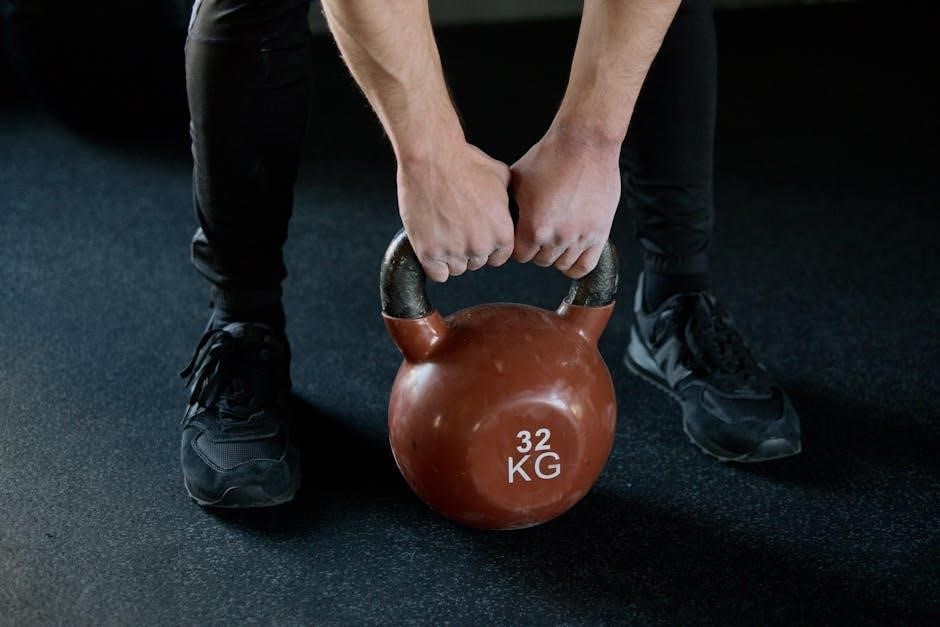
Kettlebells are cast-iron or steel weights resembling a cannonball with a handle attached. Unlike traditional dumbbells, the offset center of gravity challenges your stability and engages more muscles during exercises. This unique design makes kettlebell workouts incredibly efficient for building functional strength, power, and endurance.
Originally used for weighing goods in Russian markets, kettlebells have a rich history in strength training. Today, they’re a popular choice for athletes and fitness enthusiasts alike. Numerous beginner kettlebell workout PDFs detail how to safely and effectively incorporate these versatile tools into your routine. They aren’t just about brute strength; they demand coordination and core engagement, leading to a well-rounded physical development.
Benefits of Kettlebell Training
Kettlebell training provides a multitude of benefits, extending far beyond traditional weightlifting. It’s a fantastic cardiovascular workout, improving heart health and endurance simultaneously with strength gains. The dynamic movements engage multiple muscle groups, boosting metabolism and aiding in fat loss.
Furthermore, kettlebells enhance core stability, improve posture, and increase flexibility. Many beginner kettlebell workout PDFs emphasize proper form to maximize these advantages and minimize injury risk. Unlike isolated exercises, kettlebell movements are functional, mimicking real-life activities. This translates to improved performance in everyday tasks and other sports, making it a truly holistic fitness approach.

Essential Kettlebell Exercises for Beginners
Beginner kettlebell workout PDFs often feature foundational movements like swings, squats, and deadlifts. Mastering these builds a solid base for more complex exercises.
Kettlebell Swing
The kettlebell swing is a cornerstone exercise, frequently detailed in beginner kettlebell workout PDFs. It’s a dynamic, hip-hinge movement, not a squat, powering the kettlebell forward using glutes and hamstrings.
Maintain a flat back throughout the movement, engaging your core for stability. Avoid rounding your spine, as this can lead to injury. The kettlebell should rise to chest height, driven by the hips, not the arms.
Focus on explosive power and controlled descent. Beginners often start with a lighter weight to perfect form before increasing the load. Proper technique is paramount for maximizing benefits and preventing strain, as highlighted in many instructional guides.
Goblet Squat
The goblet squat, a fundamental exercise often featured in beginner kettlebell workout PDFs, is excellent for building lower body strength and improving squat form. Hold the kettlebell close to your chest, like a goblet, throughout the entire movement.
Keep your back straight, core engaged, and elbows pointing downwards. Squat down until your thighs are parallel to the ground, maintaining a neutral spine. This kettlebell placement encourages proper posture and depth.
The goblet squat is a great starting point for beginners as it promotes balance and stability. Many guides emphasize controlled movements and focusing on feeling the exercise in your legs and glutes.
Kettlebell Deadlift
The kettlebell deadlift, frequently detailed in beginner kettlebell workout PDFs, is a powerful exercise for strengthening the posterior chain – your back, glutes, and hamstrings. Stand with feet shoulder-width apart, kettlebell centered between your feet.
Hinge at the hips, keeping your back straight and core engaged, and grasp the kettlebell. Drive through your heels, lifting the kettlebell by extending your hips and knees. Maintain a neutral spine throughout the lift.
Beginners should focus on mastering the hip hinge movement before adding significant weight. Proper form is crucial to prevent injury; many resources emphasize controlled movements and avoiding rounding the back.
Kettlebell Turkish Get-Up (Simplified)
The Kettlebell Turkish Get-Up, often found in advanced beginner kettlebell workout PDFs with modifications, is a complex but rewarding exercise building full-body strength and stability. Start lying on your back, holding the kettlebell extended towards the ceiling with one arm.
Begin by rolling onto your opposite elbow, then push up to a seated position, keeping the kettlebell stable overhead. Continue to a lunge position, then stand up, maintaining control of the kettlebell. Reverse the steps to return to the starting position.
Beginners should practice each segment separately, focusing on controlled movements and core engagement. Prioritize form over weight to avoid injury and build a solid foundation.

Building Your Beginner Kettlebell Workout
Beginner kettlebell workout PDFs often emphasize structured routines. Incorporate a warm-up, focused exercises, and a cool-down for optimal results and injury prevention.
Warm-up Routine
A proper warm-up is essential before any kettlebell workout, preparing your muscles and joints for the demands ahead. Many kettlebell workout for beginners PDFs highlight this crucial step. Begin with 5-10 minutes of light cardio, such as jogging in place or jumping jacks, to elevate your heart rate.
Follow this with dynamic stretching, focusing on movements that mimic the exercises you’ll be performing. Include arm circles, leg swings, torso twists, and hip rotations. Gentle kettlebell swings with a very light weight can also be incorporated. This prepares the specific muscle groups used in kettlebell training. Prioritizing a thorough warm-up minimizes the risk of injury and maximizes workout effectiveness.
Workout Structure: Sets and Reps
When starting with kettlebells, a conservative approach to sets and reps is best, as many kettlebell workout for beginners PDFs recommend. Aim for 2-3 sets of 8-12 repetitions for each exercise. Focus on maintaining proper form throughout each rep, rather than lifting heavier weights or completing more repetitions.
Rest for 60-90 seconds between sets to allow for adequate recovery. As your strength and endurance improve, you can gradually increase the number of sets, reps, or the weight of the kettlebell. Listen to your body and adjust the workout accordingly. Prioritize quality over quantity to prevent injury and build a solid foundation.
Cool-down and Stretching
A proper cool-down is crucial after any kettlebell workout, and many kettlebell workout for beginners PDFs emphasize this. Begin with 5-10 minutes of light cardio, such as walking, to gradually lower your heart rate. Following cardio, dedicate 10-15 minutes to static stretching, holding each stretch for 30 seconds.
Focus on stretching the major muscle groups worked during the workout, including the hamstrings, glutes, back, shoulders, and core. Stretching improves flexibility, reduces muscle soreness, and aids in recovery. Remember to breathe deeply throughout each stretch. Consistent cool-downs enhance long-term fitness gains and prevent injuries.

Choosing the Right Kettlebell Weight
Kettlebell workout for beginners PDFs often guide weight selection based on fitness level. Start lighter to master form before increasing the challenge.
Weight Selection Guide for Women
For women new to kettlebell training, starting with a lighter weight is paramount; Many kettlebell workout for beginners PDFs recommend beginning with an 8kg (18lbs) or 12kg (26lbs) kettlebell. This allows you to focus on mastering proper technique without risking injury.
Consider your current fitness level; if you regularly engage in strength training, the 12kg option might be suitable. However, if you’re entirely new to exercise, begin with the 8kg kettlebell. Progress gradually, increasing the weight only when you can comfortably perform exercises with good form for the recommended repetitions. Don’t be afraid to start even lighter – a 4kg (9lbs) kettlebell is a great option for building foundational strength and coordination. Prioritize form over weight to maximize benefits and minimize risk.
Weight Selection Guide for Men
Men starting kettlebell training should generally begin with a heavier weight than women, but proper form remains the priority. Many kettlebell workout for beginners PDFs suggest starting with a 12kg (26lbs) or 16kg (35lbs) kettlebell. Your current strength level is a key factor in determining the appropriate weight.
If you have a background in weightlifting, the 16kg option could be a good starting point. Otherwise, begin with the 12kg kettlebell to focus on technique. As you gain strength and proficiency, gradually increase the weight. Don’t rush the process; prioritize controlled movements over lifting heavier loads. A 20kg (44lbs) kettlebell is a common next step, but listen to your body and progress at your own pace.

Common Kettlebell Mistakes to Avoid
Beginner kettlebell workout PDFs often highlight common errors. Maintaining proper form is crucial; avoid rounding your back and relying on momentum instead of strength.
Rounding Your Back
Rounding your back during kettlebell exercises, particularly swings and deadlifts, is a prevalent mistake often addressed in beginner kettlebell workout PDFs. This compromises spinal stability and significantly increases the risk of injury, potentially leading to strains or more severe back problems.
Maintaining a neutral spine – a natural curve – is paramount. Imagine a straight line from your head to your tailbone. Engage your core muscles throughout the movement to support your spine and prevent it from collapsing. Focus on hinging at the hips, not bending the back. Proper technique, emphasized in instructional materials, prioritizes a strong core and controlled movements over lifting heavier weights.

Practicing with lighter kettlebells and focusing on form before increasing the weight is essential for preventing this common error.
Using Momentum Instead of Strength
A frequent error highlighted in beginner kettlebell workout PDFs is relying on momentum to complete repetitions, rather than engaging the targeted muscle groups. While a degree of natural swing is inherent in exercises like the kettlebell swing, it shouldn’t be the primary driver of the movement.
True strength comes from controlled exertion. If you find yourself excessively using your arms or back to “fling” the kettlebell, reduce the weight and focus on initiating the movement from your hips and core. Slow down the tempo and concentrate on feeling the muscles work throughout the entire range of motion.
Prioritizing controlled strength builds a solid foundation and prevents injury, ensuring effective and sustainable results.

Sample Beginner Kettlebell Workout Routines
Beginner kettlebell workout PDFs often include routines focusing on full-body strength or specific muscle groups, performed 2-3 times weekly for optimal results.
Full Body Kettlebell Workout (3 times a week)
This routine, frequently found in beginner kettlebell workout PDFs, is designed for three non-consecutive days per week, allowing for adequate recovery. Begin with a 5-minute warm-up, including dynamic stretches like arm circles and leg swings.
Perform 3 sets of 10 repetitions for each exercise: Kettlebell Swings, Goblet Squats, Kettlebell Deadlifts, and Kettlebell Rows. Rest for 60-90 seconds between sets. Focus on maintaining proper form throughout each movement to prevent injury.
Adjust the kettlebell weight based on your fitness level, prioritizing technique over heavier loads. Conclude with a 5-10 minute cool-down, incorporating static stretches targeting major muscle groups. Consistency is key for seeing results!
Lower Body Focused Kettlebell Workout
Many beginner kettlebell workout PDFs emphasize lower body strength, and this routine delivers! Perform this workout 2-3 times weekly, with rest days in between. Start with a 5-minute dynamic warm-up, focusing on leg swings and hip circles.
Complete 3 sets of 12-15 repetitions of each exercise: Kettlebell Goblet Squats, Kettlebell Romanian Deadlifts, Kettlebell Lunges (each leg), and Kettlebell Swings. Rest for 60-90 seconds between sets.
Prioritize controlled movements and proper form. Select a kettlebell weight that challenges you without compromising technique. Finish with a 5-10 minute cool-down, holding static stretches for your quads, hamstrings, and glutes.
Kettlebell Safety Considerations
Beginner kettlebell workout PDFs often stress safety. Prioritize proper form to prevent injuries, listen closely to your body, and start with lighter weights.
Proper Form is Crucial
Maintaining correct form during kettlebell exercises is paramount, especially for beginners. Many beginner kettlebell workout PDFs emphasize this point repeatedly, often including detailed visual guides and step-by-step instructions. Incorrect technique can lead to strains, sprains, and more serious injuries.
Focus on engaging your core throughout each movement to stabilize your spine and protect your lower back. Avoid rounding your back, particularly during swings and deadlifts. Keep your chest up and shoulders back. Prioritize controlled movements over speed or heavy weight. Watch videos, practice in front of a mirror, and consider working with a qualified trainer to ensure you’re executing each exercise correctly. Proper form builds a solid foundation for progression and maximizes the benefits of kettlebell training.
Listen to Your Body
Paying attention to your body’s signals is essential when starting any new exercise program, and kettlebell training is no exception. Many beginner kettlebell workout PDFs will advise starting slowly and gradually increasing intensity. Don’t push through pain; differentiate between muscle soreness and actual injury.
Rest when you need to, and don’t hesitate to modify exercises if they feel uncomfortable. If you experience sharp or persistent pain, stop immediately and consult a healthcare professional. Remember that recovery is just as important as the workout itself. Prioritize adequate sleep, hydration, and nutrition to support your body’s healing process and prevent overtraining; Respect your limits and progress at your own pace.

Resources for Further Learning
Numerous online resources, including downloadable kettlebell workout PDFs, offer detailed guidance. Explore programs and materials to deepen your understanding and technique.
Recommended Kettlebell Workout PDFs
Finding reliable, beginner-friendly kettlebell workout PDFs is a great starting point. Many fitness websites and trainers offer free downloadable resources. Look for PDFs that clearly illustrate proper form for exercises like swings, goblet squats, and deadlifts.
Several PDFs focus specifically on introductory routines, often including warm-up and cool-down sections. Websites like Nerd Fitness and Kettlebell Kings frequently provide valuable downloadable content. Be sure to prioritize PDFs created by certified fitness professionals to ensure safety and effectiveness.
Remember to assess your current fitness level before starting any new workout program, and always listen to your body. A well-structured PDF will guide you through progressions, helping you build strength and technique gradually.
Online Kettlebell Training Programs
For a more structured approach, consider exploring online kettlebell training programs. These often provide video demonstrations, personalized feedback, and progressive workout plans, building upon foundational movements. Platforms like Kettlebell Kings and Flowstate Fitness offer comprehensive courses suitable for beginners.
Many programs cater specifically to those new to kettlebells, emphasizing proper technique to prevent injuries. Some subscriptions also include access to a community forum for support and motivation. While beginner kettlebell workout PDFs are useful, online programs offer a more interactive learning experience.
Evaluate program reviews and instructor credentials before committing. Look for programs that prioritize form over weight, ensuring a safe and effective introduction to kettlebell training.